Showing posts with label I (heart) Great Design. Show all posts

Wednesday, January 1, 2014

Top 10 Games of 2013

2013 is now over, and in terms of games, it was arguably one of the best years ever! Picking 10 games to highlight as the best was not an easy chore. In fact, it was excruciatingly difficult. There were plenty of surprises, for sure. Ultimately, I chose these ten games based entirely on how much pure enjoyment I got out of them and how impressed I was with how well they executed their vision. As a designer, I covet clever design and excellent implementation. Enjoyment doesn't always mean "fun"... in some of these cases, I got enjoyment out of how satisfying they were, or how impressed I was with them, even if they weren't pure fun. These are the 10 most impressive games of 2013.


SteamWorld Dig came out of nowhere and blew me away. One of the biggest surprise hits of the year, SteamWorld Dig combines some light roguelike elements with a decidedly Metroidvania-esque game progression to deliver one of the most addictive, and rewarding, games of 2013.

Digging is what you'll do, and you'll do a lot of it. The  game's progression is based entirely on digging deeper and deeper into the Earth to find clues of a lost civilization and to discover what happened to the previous explorers. With each swing of your pickaxe you'll descend deeper into the ground, into dark unknown areas searching for precious ores and avoiding dangerous enemies. You'll need to return to the surface with your spoils to buy upgrades that will let you return to the dark caverns and dig even deeper. It's a nice, smart gameplay loop that kept me hooked for the entire duration. Dig, discover, upgrade, dig. The sense of progression was finely tuned just enough that this never, ever becomes tedious or tiresome. And that's a great achievement.

If you have a 3DS and you're looking for a great, original game you should definitely pick this one up! You can even get it on Steam now, too!


Very rarely has a game won me over on mere premise alone, but Papers, Please is based on such a brilliant concept; described as a "Dystopian Document Thriller", you take on the role of an immigration inspector at the border of a fictional communist nation that is besieged by war. You are tasked with checking the documents of civilians trying to enter to country. You do this by checking dates, facts, and turning away any who don't have their documents in order.

Inspiring premise aside, the game design is equally brilliant; featuring time-pressured gameplay, moral ambiguity and satirical social commentary. If you wanted to be overly-simplistic, you could call it a puzzle game, requiring players to observe patterns and react accordingly. A keen eye and an even better memory are required for playing as you'll have a ton of bureaucratic rules and laws to remember as you process civilians at the Arstotkan border. Be warned, though... This game is dark, depressing and occasionally shocking in its bleakness.


Samurai Gunn is straight up my new jam. This lightning fast 4-player fighting game is like Bushido Blade on speed. Death comes quick and your reflexes are the only thing that can save you. Often compared to Towerfall, I prefer the breakneck pace of Samurai Gun. Fights last seconds and matches (first to 10 kills, typically) take mere minutes. The movement and controls are very Meat Boy-like (the momentum from wall jumping for example feels very familiar). The attacks are instantaneous and the ability to deflect bullets with your sword makes every attack count. You can even ping-pong bullets back and forth between two players in a Link/Ganondorf style duel.

The fact that many, many "WOW" moments will happen within a 90 second match is what makes Samurai Gunn the best multiplayer game of 2013.

A lack of features keep the game from ranking higher on the list. But what little there is, is pure gold!


One-on-one fights in Samurai Gunn are good... but if you can get 4-players in on the fun, then the game rivals Super Smash Bros for pure fun, it's that good!


Tearaway is the PS VITA game. It uses pretty much every feature of the system, quite intelligently, and allows you to interact with the game's world in some of the most charming and imaginative ways. Taking place in a papercraft world, you a free to peel away stickers to reveal platforms, cut out shapes to create items and take pictures to find secrets. Media Molecule knows how to lay on the charm, and they've created something even more endearing than LittleBigPlanet.

What may be surprising, is that the game has a really great story and an ending that ranks among my favorites of all time! With a ton of hidden secrets to find, there's plenty of reasons to revisit and replay areas from the game.

The only complaint I have is that, for all the game's charm, the platforming is pretty rubbish (which isn't too surprising considering the LBP games also had less than stellar platforming). Overall, it's a game that is far more charming than it is excellent, but I can't deny that I was smiling the whole way through, and that counts for a lot.


I loved BioShock Infinite. In the tradition of BioShock games, the world that was presented was excellently fleshed out, endlessly intriguing and incredibly haunting. I devoured the game and loved every minute of it. I completed a second playthrough in one single sitting, just to go through the paces of the story a second time.

By the end, I had grown quite close to both Booker and Elizabeth and was quite blown away with the game's ending (don't worry, no spoilers). The way in which I walked through the game's ending is what I remember most fondly, as it was the perfect way to present that ending. There may have been a few plot holes (plot tears?), but overall I was fully engaged from start to finish. Plus, zip-lining is excessively awesome!

A few uninspired "boss fights" and little bit of needless meandering in the game's middle section are about the only bad things I can point out about BioShock Infinite. As with most of the game's on the list, the biggest knock against it is that it came out in a year with so many excellent games. In virtually any other year, this would have ranked higher.


Grand Theft Auto V is a game that is grand, in the truest sense of the word. Los Santos is an amazing sight to behold, as it is one of the most fully-realized game worlds ever created. The story is tight and well told, well paced and well presented. The characters are fully fleshed out and the acting is spot-on. The decision to include three separate, playable protagonists pays off huge, and is one of the game's greatest strengths. The transitions between characters (with the zoomed out birds-eye view of the city) was technically impressive. Best of all, I have a hard time choosing which character is my favorite, I enjoyed all three.

But ultimately, it's about the moments... GTA V is filled with amazing moments; some scripted moments that were carefully created and presented to the player (like chasing a crashing plane on a motorcycle, or any one of Trevor's antics), and some moments that you create as you play within the game's open-world sandbox (like a police chase that starts on the highway and ends in the ocean). Rockstar proves, like they always have, that they are masters of the living, breathing, open-world game.

My only complaint about GTA V is the decision to add the medal ratings for each mission (gold, silver, bronze). I consider myself quite the completionist, but there's so much content in a typical GTA game, that there is no reason to artificially create replay value with a system like this. I don't want to ever replay a mission in GTA, I find enjoyment from the fact that there is always something to do. And GTA V has more side-diversions than ever. It definitely struck me a strange and unnecessary design addition.


Powerful, meaningful moments are important... and perhaps no single "moment" in any game this year was better, or more impactful than The Last of Us's ending.

I actually did not find TLoU much fun to play, in fact I hated some parts of the game, purely from a gameplay standpoint. But, The Last of Us is more than its gameplay, it truly is an experience. Many games have great voice acting and great stories... but not like this. Naughty Dog are at the top of their game, and are among the best developers in the industry. As with Papers, Please, The Last of Us is incredibly bleak. It's a weighty experience that never comes off disingenuous or forced, and that's it works. Something like this could only have been accomplished by the best talent in the industry, and I absolutely respect that.

I definitely preferred the times when I wasn't playing the game -- watching the characters interact, listening to them talk and looking at the incredibly detailed world -- was actually better than playing. This is a game that I won't mind setting to 'Easy' and playing through, just so I can experience it again.

Despite my gripes and the game's lows, it's the heights to which The Last of Us reaches that puts it this high on the list.


The Legend of Zelda: A Link Between Worlds brought freedom, choice and exploration back to Zelda for the first time in decades. A sequel to my favorite Legend of Zelda game, A Link to the Past, LoZ: ALBW takes place in the same world, features the same map and many familiar characters. Yet, it's so amazingly fresh and unique, thanks to the game's open-ended, exploration rewarding nature.

The best part of the game? Comparing the order in which you've completed the game's dungeons with that of your friends, and seeing how you all played the game radically different. Throw in an awesome updated visual style and dungeons that are still a master-class in level design, and you've got one of the best Zelda games... ever!


I was completely unprepared for what Gone Home had in store for me.

I very recently played Gone Home (just two days ago, in fact). I had managed to avoid hearing anything about it, and I am so glad that I did. I didn't even read the Steam product page for the game when I bought it, I just clicked "purchase". And I'm glad I did, too... as both the description and the review quotes contained spoilers!

I'm going to try and keep this completely spoiler free, even if that means being incredibly vague.

Gone Home is masterful. The storytelling, the sense of discovery, the pacing... all of it is perfection. When I had finished the game, I realized that I was free to explore the game how I wanted and was free to do so at my own pace. I was completely free. And yet, I had uncovered the story exactly how the developers wanted me to. That takes genius to accomplish, and every moment of it felt natural, and intuitive. Like Papers, Please, I was sold on Gone Home based on premise alone. It immediately struck me as so genius, and so intriguing. I am so glad to say that I was not disappointed. In fact, my expectations were blown away!

This truly is a new kind of storytelling, and the story it told was so powerful, so meaningful and so honest that it nearly brought me to tears.

I want to dissect everything about Gone Home, because I know I can learn from it. And that's not something I can say for many games. I will attend every GDC session about Gone Home, and would love to talk about it with anyone from The Fullbright Company.

Set aside two hours, and play it in one single, uninterrupted session.


Where Gone Home was a transcendent experience that will stick with me forever, Super Mario 3D World is the purest display of what I covet in gaming and why I became a developer in the first place. Easily the most polished game of 2013, Super Mario 3D World is nothing short of a masterpiece. It looks fantastic, it plays like a dream and it features some of the best level design I've ever seen.

Super Mario 3D World is a great game, but it is the level design that puts it at #1 on this list. As a Level Designer by trade, I am in complete awe of what was accomplished in SM3DW. Each level in the game is built around a single mechanic or theme, and as a player you will be taken on a journey that presents said mechanic or theme in every deliciously brilliant way possible. For example, you'll begin playing a level about rolling logs, and by the end you will experience so many ways in which those rolling logs can be used. And most of the time the absolute cleverness of the mechanics will shine through.

The only downside is that the best content (the best levels) are hidden in the post-game content. But if you stick with the game and play everything that the game throws at you, you'll have experienced some of the best levels in any game today. I hope to one day be this good at level design. Gone Home was absolutely a transcendent experience, but as a very nuts-and-bolts style designer, I love game mechanics. And Super Mario 3D World was genius in its implementation, experimentation and exploration of its mechanics.

And Champion's Road. Champion's Road is one of the best levels ever.


What a year!

Thursday, April 19, 2012

Fez: Impresions and Admirations

Fez was released on Xbox LIVE Arcade last Friday, after five years in development. It's a game that I have been watching very closely, with a great deal of anticipation, for much of that time (I first remember Fez being on my radar in 2009).

I'll start off by saying that if you don't know anything about Fez, check out this video for a brief introduction, and stop watching as soon as it's sold you on its concept. You definitely don't want anything about this game spoiled for you (and I will keep this post spolier-free, as well).


Fez has an absolutely beautiful retro look and as you can see from the video, the game gives the player the ability to shift their perspective of the world and view it from a different angle. Gomez, the main character of Fez, is described as a "2D creature living in a 3D world". The game typically plays like a traditional 2D platformer with running and jumping being Gomez's primary methods of traversing the game world. But even the platforming is not so simple, Gomez can grab onto ledges to hoist himself up onto them and he can scale some walls (keep an eye out for plant growth). This gives Gomez a ease of mobility that is greater than what is typically seen in the average platforming game.

As for the ability that the player has to rotate the view and see the level from a different perspective, well even that is not a simple as it first seems. You can check out this post by Fez programmer Renaud Bédard about how the game is built out of trixels (warning: highly technical). Technicalities aside, what it comes down to is that when viewing the world of Fez, what you're seeing has no depth. Everything you see is, for all intents and purposes, side-by-side (even if, just a moment before things were far apart in another view). This concept makes the platforming sections all the more enjoyable and adds a minor puzzle-like element to the game.

Making the platforming interesting and thought provoking is very important to the game, as that is what the game is entirely about. There are no enemies in Fez, no weapons, no special abilities. Just Gomez, exploring a fantastically detailed and beautifully alive world.

I can honestly say that Fez is one of the most enjoyable and fulfilling gaming experiences I've ever had, and while I've "completed" the game (the main story)... I've only just begun to scratch the surface.

Because there comes a point when you truly understand what Fez is really all about.

I will not spoil anything here (which I could barely do, even if I wanted to, as I haven't even figured it all out yet), but there is an entirely new layer to the game that you eventually discover. Something that reminds me of gaming days long past. I have been gleefully playing Fez with a notebook and pen on my coffee table, writing down symbols, deciphering clues and (trying) to solve mysteries. There are some deep, well hidden secrets in Fez, and I am determined to find them, on my own.

I am willing to consult with friends and trade ideas with fellow gamers, but I am refraining from looking to the internet for any assistance. It's proving to be a tall order, seeing how the puzzles in Fez are some of the most devious I've ever encountered. If you liked the show Lost, and were caught up in the mysteries of the island as well as it's cryptic messages and numbers, then you'll love Fez. It's just like that. There's a lot of speculation and searching going on right now as I try to unravel these secrets.

In fact, I'd say that I'm having just as much talking about Fez's mysteries as I am playing the game itself. It really is quite brilliant!

Simply put, Fez is one of the greatest games I've ever played and has secured a place as one of my all-time favorites. I greatly respect and admire the talented individuals who created this great experience.

If you've got an Xbox 360, download Fez, right now.

Tuesday, February 14, 2012

I (heart) Great Design: Best Boss Fight of 2011

Disclaimer: possible (minor) Batman: Arkham City spoilers below

Last year was a great year for games. One of the best in recent memory, in fact. In this edition of I (heart) Great Design, I would like to write about one of my highlights from 2011: The Mr. Freeze boss fight from Batman: Arkham City.


The fight against Mr. Freeze is one of the standout moments in this absolutely stellar game. It's a sneaky, cat-and-mouse, head-to-head showdown that requires the use of almost every skill that you've learned and mastered up to that point in the game. As Batman, you have to sneak around Mr. Freeze's lab and continuously find new ways to take him by surprise. And you can use each tactic only once, because Mr. Freeze adapts his own strategies to protect himself against your attacks.

When the fight begins, Batman gets a rundown on Mr. Freeze's suit uploaded to him from his trusty Bat-computer. You get information on Mr. Freeze's twelve weaknesses. For example, because of the domed helmet that Freeze wears, he has a complete lack of peripheral vision. This allows you to easily sneak up behind him and land an unexpected blow. However, upon being hit from behind, Mr. Freeze activates a counter-measure that fires a stream of ice continuously out of the rear of his suit, so he can longer be attacked from behind.

Now you have to find another one of Freeze's weaknesses to exploit.

The whole sequence is a welcome change from the traditional boss fight (strike, strike, dodge. Dodge, strike, dodge. Honk, honk, brake!). It requires strategic planning and effective use of a wide arsenal of abilities. You even have to find clever uses for the bat-gadgets you've obtained up until that point.

This was a great segment of gaming goodness that was possible thanks to some great design.

Also, since it's Valentine's Day: a reminder to anyone playing Batman: Arkham City, don't forget to visit Calendar Man today!

Tuesday, January 31, 2012

I (heart) Great Design: Morality in games

I just recently acquired the Platinum Trophy in Dark Souls, and I’ve been looking back on the experience quite fondly. It was a great 130 hours; about 20 hours longer than it took to get the Platinum Trophy in Skyrim. It was a long and challenging road and one of the best gaming journeys I’ve been on in a while.

I had such a good time that I even decided last night to start the whole thing over again, with a new character. From scratch. It started off well enough, I was able to breeze through the introductory section of the game easily enough. But then I encountered something quite jarring… I was griefed. Hard.

For those not entirely familiar with the “Souls” games (Dark Souls and its spiritual predecessor Demon’s Souls): players can invade other players’ game worlds and attack them to gain souls (the game’s currency system - and other circumstance-specific rewards). Because Dark Souls is such a difficult game, things get especially tense when an additional opponent is thrown into the mix. It puts you on edge as much as classic survival-horror games used to.


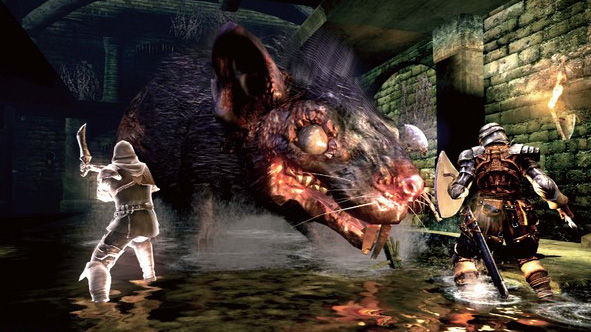
Pictured Above (from right to left): an honorable knight(on stairs), and an asshole

Because I started playing the game immediately at launch (I had the game pre-ordered months in advance), I guess I was progressing alongside most other players in the world. The times I had encountered invading players, we were (mostly) evenly matched. I’ve won (and lost) many tense 1-on-1 duels with invading Black Phantom players.

Getting back to the story of griefing… Starting with my fresh, new Level 12 character, I was traveling through the game’s first area. Suddenly I was invaded by another player. I’ve experienced this before, so I was ready for what was to come. As a Level 12 character (a very basic low-level character), I was fully expecting to go head-to-head with a similarly powered phantom. It did not happen that way. I was completely overmatched by someone decked out in high-level gear and a giant flaming sword that struck me down in one hit. Only, it wasn’t quite so quick. He stood in place, taunting me repeatedly, and even invited me to strike him a few times with my pitiful broadsword that barely even scratched him.

After he killed me, I revived. I did not take long, however, for another crazily overpowered Black Phantom to invade my game and ruin things for me. With no possible way to fight back, it was a rough and thoroughly unpleasant experience. It took some searching on some forums online, but I was able to find out that there is a practice going around where players are beating the game at a ridiculously low level, starting a New Game+ (which lets them keep all of their end-game gear), and then thoroughly trouncing low-level beginner players.

This brings me to my topic: Morality in Games.

Many games offer morality as a very superficial narrative device. A common occurrence in modern RPGs, you’ll meet a character who will have a problem. It’s up to you as a player to either do something “good” or you could do something “evil”. It’s quite cut and dry. And often times, your decision will have very little to no impact on the game’s story and outcome.

What is even more effective is when the game allows you, the player, to express your own morality through the game. Not with “A or B” choices, but through your actions and how you carry yourself.

I’ve Platinum’d both Demon’s Souls and Dark Souls, clocking in about a combined 300+ hours of gameplay, and I’ve never, ever invaded another player. I just can’t do it. That is to say, I don’t hate those who do. Invading is an integral part of these games, and I will always welcome a (fair) challenge. I much prefer to assist others by joining them as a White Phantom (entering another player’s game world, with the express intent on helping them).


Pictured above: the Dark Souls equivalent of an upstanding
citizen helping someone murder a 20-foot rat

More games need to include this kind of subtlety. When it comes to something like morality, don't give me a binary "good vs evil" dialogue choice, let my everyday game actions define who I am as a player.

Sunday, May 29, 2011

I (Heart) Great Design: #1

Here's a new bi-weekly feature that I'll be posting here: I (Heart) Great Design where I talk about some of the features and elements of games that have most impressed me and have stuck with me over the years.

So, in this first installment I would like to call out a particularily good level in a very overlooked game.

The Great Tower from the SNES game Skyblazer.

The Great Tower is the second to last level in the game and it is remarkable because it's a great example of a how to build a final area that culminates with you having to use everything you've learned about that game up to that point. This level features enemies from every area in the game and requires you to use every ability you've gained throughout the adventure.

It truly is the "Skyblazer final exam".

This is a design element that I believe should be in every game. Using the combined knowledge of everything you've encountered to overcome one final challenge, it's exactly how a game should build towards its conclusion.

Games that effectively pull this off: all of the games in the Legend of Zelda series.

The final dungeon in a Zelda game always requires you to use every piece of arsenal you've collected to get through. It's nice because it typically gives you another use for that all too specific item that was quite under-used throughout the game (I'm looking at you, Spinner).

Games that surprisingly don't: Metroid games (makes me so sad).

Actually, Metroid games almost always have disappointing final areas. The final area of a Metroid game is always a very linear, and straightforward experience (see: Tourian from Super Metroid or the Impact Crater from Metroid Prime), which is strange as this conflicts with the very nature of the rest of the game. These final areas very rarely require you to use an of your abilities either, they're the complete antithesis to what I'm pointing out in this entry.

It seems that Metroid can learn something from a 15 year old SNES game that hardly anyone has played. Or, (more likely), Metroid can learn from Zelda games...

Either way, I'd like to see more games use this kind of design in their endgame sequences.

The most recent example that I can think of is the Grandmaster Galaxy from Super Mario Galaxy 2. I could write a whole 'nother entry about the Grandmaster Galaxy. In fact, I'm going to do just that.